
Picture hanging
Gallery Rail or Traditional Picture Hanging?
Flexibility, wall construction, load and visual preference determine whether a rail or fixed hanging works better.
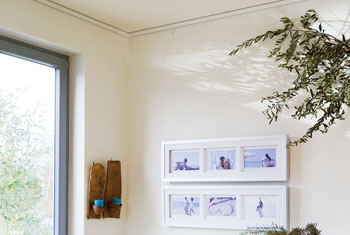
Gallery rails are especially useful for changing displays; a fixed hanging can appear quieter for a permanent single position. A successful display starts before the first hole is drilled. Sightlines, wall dimensions, daily use and the real weight of each work need to be understood together.
For Berlin homes, practices and offices, BBG can coordinate rail, hooks and picture formats as one complete system. Photographs and measurements prepare the plan. Whether how often the display may change works as intended often becomes clear only in the room: where is the work first seen, what stands in front of it, and how does light change?
Read the room from normal viewpoints
To assess how often the display may change, move between the entrance, usual seating positions and main circulation routes. Furniture edges, doors and existing pictures often create more visual order than an abstract centre point.
Use removable paper tape or full-size templates to mark outer edges. This also tests visibility of rail, cord and hook without damaging the wall. See Compare gallery rails for relevant hanging or interior-art options.
Coordinate scale, spacing and height
- How often the display may change. Check this aspect from the viewpoints that people actually use in the room.
- Weight and size of the pictures. Mark spacing and axes with templates before making holes in the wall.
- Wall construction and drilling options. Use the outside dimensions of frame or object and include its depth.
- Visibility of rail, cord and hook. Treat weight, wall construction and fixing as one technical task.
Measurements should not be read in isolation. When checking weight and size of the pictures, use the actual outside dimensions rather than image size alone. Gaps within a group normally feel tighter than distances to furniture or room corners. In particular, avoid confusing the load limits of individual components.
Record your observations about wall construction and drilling options during the trial arrangement. Deep canvases and three-dimensional objects also have a side view. Picture framing in Berlin provides further help when comparing formats.
Complete the plan before installation
Record outside dimensions, weight, hanging points and intended position for every work. Then identify wall construction and possible services. A frequent planning error is choosing a rail without suitable wall fixing.
For weight and size of the pictures within a group, install from the main axis outwards. Arrange the works on the floor first or use templates. Small measuring errors can then be corrected before installation.
Avoid problems before they reach the wall
- Confusing the load limits of individual components.
- Choosing a rail without suitable wall fixing.
- Planning cord lengths only after installation.
A spirit level cannot answer every visual question. Historic rooms may contain cornices, uneven floors or dominant furniture lines. Resolve planning cord lengths only after installation before the final fixing is made.
Include light and protection
Art for interiors provides further information for this stage of planning. Reflections are created by window, lamp, glazing and viewing angle and may change the assessment of wall construction and drilling options. Test the position in daylight and after dark.
For larger or changing displays, consider visibility of rail, cord and hook together with frame, wall and fixing. Personal advice provides the relevant details. Include doors, radiators, lamps and normal circulation routes.
Test before making the fixing permanent
View the proposed position close up and from the normal distance. Open doors, occupy the usual seats and switch on existing lamps. Pay particular attention to how often the display may change. A photograph records the test before the fixing becomes permanent.
Hanging Pictures at the Right Height develops a neighbouring presentation question. It adds context to visibility of rail, cord and hook and supports a solution that remains understandable when the room or group changes later.
How often the display changes should guide the system
A gallery rail earns its place when pictures are rotated, expanded or regrouped. In a practice, office or flexible home interior, heights can change without adding new holes to the wall. The trade-off is that cords and hooks remain visible to some degree. For one work intended to stay in a permanent position, a direct fixing may look quieter and less technical.
Safety in either system is determined by the weakest connection. A rail depends on wall fixing, rail, cord, hook and frame attachment. A fixed hanging depends on wall material, anchor, screw and hanger. The load rating printed for one component should never be treated as the rating of the complete installation.
Before choosing a system, consider how often the display is likely to change. A rail can prevent repeated drilling in a collection that is rehung regularly; one heavy work may be better served by a direct fixing designed for its wall and load. The deciding factor is not the system name, but how reliably it carries the actual frames.
A gallery rail keeps the wall flexible, but its cords become part of the visual result. Light cords may recede against a white wall, while dark surfaces or side lighting make them more noticeable. A direct fixing can therefore suit one permanent, very calm display. For changing groups, the ease of adjustment often outweighs the visible suspension.
Cornices, suspended ceilings and hidden services may affect where a rail can be fixed. Establish a sound mounting line early and check that the available cords can reach the intended picture height without unnecessary loops or extensions.
Conclusion
A convincing display combines spatial effect with safety. Review how often the display may change, weight and size of the pictures, wall construction and drilling options and visibility of rail, cord and hook before installation and test them in the real room. The result should suit the art and everyday use without imposing a rigid formula.
Frequently asked questions
Can a gallery rail carry heavy pictures?
That depends on the rail, wall fixing, cord, hook and load distribution. The weakest component sets the limit.
Are the cords always visible?
Their appearance changes with material, light and wall colour. Transparent and metallic versions create different effects.
Is a rail worthwhile for one picture?
A fixed hanging may be enough for a permanent single position. A rail becomes useful when later changes are likely.
Related guides
Would you like personal advice in Berlin?
Bring your questions, room situation or artwork to Berliner Bilder Galerie. We will help you compare suitable options for art, framing and presentation.