
An inherited painting may have a dark surface, cracks or a distracting repair. Berliner Bilder Galerie at Kaiserdamm 5 welcomes enquiries about paintings believed to date from the sixteenth, seventeenth or eighteenth century. We discuss the information available and what assessment is needed before considering treatment. An apparent age is neither an attribution nor a diagnosis.
Enquire about an old paintingThree questions before painting restoration
- What is known?
- Separate a suggested date or artist from information supported by records.
- What has changed?
- Dark coating, cracks or loose paint: describe visible features without cleaning the surface.
- What is the aim?
- Preservation, legibility and safe display must be considered for the individual painting.
Distinguish support, paint and surface coating
Calling a work an oil painting does not describe its whole construction. Canvas or a wooden panel supports ground and paint layers, sometimes beneath varnish. Describe what you can see without trying to diagnose it:
- Craquelure: A network of fine cracks alone establishes neither a date nor the stability of the paint.
- Losses or lifting paint: Mention these specifically. Securing vulnerable paint may take priority over improving appearance.
- A dark surface: Dirt and altered coatings need to be distinguished on the original. A dark area is not necessarily yellowed varnish.
Separate family history from documented information
A painting can arrive with a detailed family story but very little paperwork. Another may have an old sale description that has never been checked. Both are useful starting points, provided that documented facts and assumptions remain distinct. An ornate frame, darkened appearance or historical costume does not independently confirm when a painting was made. A later copy can follow a much earlier composition.
Gather existing invoices, reports and photographs without trying to uncover new evidence by cleaning the work. Let us know where a proposed date or artist's name comes from. You do not need an established attribution to ask about condition. Equally, a discussion about conservation needs should not be mistaken for authentication or a market valuation. Those are separate questions with their own evidential requirements.
Sixteenth-century paintings: start with the actual materials
Raphael's Madonna of the Pinks, dated around 1506 to 1507 by the National Gallery, is painted on wood. This does not mean that every sixteenth-century painting must be on a wooden panel. Expectations based on period cannot replace observation.
Previous condition reports and photographs showing a different frame can help document later changes. Keep these records with your enquiry. Do not remove coverings or disturb the surface simply to search for a date. The first conversation establishes what is known and what remains uncertain.
Seventeenth-century pictures: the subject can look further back
Rembrandt's Self Portrait at the Age of 34 is dated 1640 and painted in oil on canvas. In it, the artist wears clothing that refers to an earlier period. It is a useful reminder that the era represented in a portrait need not be the era in which the painting was produced.
A landscape, still life or portrait in private ownership requires its own assessment. Explain whether a seventeenth-century date is supported by a document or has simply been passed down. A visible signature may be relevant, but should not be treated as conclusive evidence by itself. Our initial discussion concerns condition and appropriate next steps, rather than confirming an artist's identity from a photograph.
Eighteenth-century works: history is not a treatment plan
The National Gallery dates Canaletto's Stonemason's Yard to about 1725 and records its medium as oil on canvas. A documented city view offers a concrete historical reference, not a model for how another painting should be restored. Similar-looking pictures may have very different structures and histories of intervention.
Even where an eighteenth-century date is well supported, the present condition needs separate consideration. What has survived, how the picture has been kept and what has already been done to it are all relevant. The museum works mentioned here are historical examples, not paintings treated by BBG. You can enquire about your painting even when its date remains uncertain.
What needs to be understood before work begins
The support, ground, paint layers, surface coatings and previous interventions can each raise different questions. A dark appearance does not automatically call for varnish removal. A photograph of cracking does not reveal everything about the adhesion or vulnerability of the surrounding paint. Images help describe the problem, but an examination of the original may be necessary.
The frame also matters. It may offer protection and support, or its fit and stability may need attention. Our restoration overview introduces the broader service. The investigation appropriate to your painting is discussed before a treatment decision. Neither a complete material analysis nor a secure attribution is promised as part of an informal image-based enquiry.
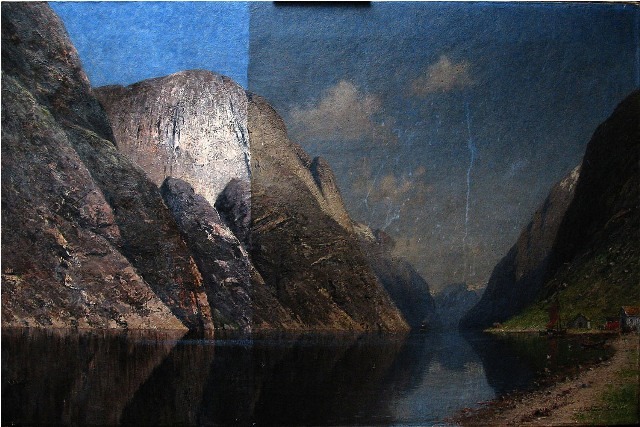
Agree an aim rather than asking for a new-looking surface
Wanting to see a composition more clearly is understandable. For an old painting, however, a newly painted appearance is not the only measure of a satisfactory outcome. Stability, legibility and the treatment of earlier changes need to be considered together. Cleaning, retouching and applying a coating are not a standard sequence that every picture should undergo.
Ask what a proposed measure is intended to achieve and what its limits are. Existing BBG illustrations show particular conditions; they are not evidence for an unrecorded date or a universal method. If the main concern is a detached corner or missing ornament, our advice on damaged picture frames addresses that more immediate question separately.
Prepare an enquiry without disturbing the painting
An overall photograph, details of visible problems and approximate dimensions provide a helpful beginning. Include an image of the back only if this can be obtained without unsafe turning or dismantling. Describe any known treatment and explain what you hope to clarify. If paint appears loose or fragments have fallen, say so before attempting to move the work for further photographs.
We can then discuss whether an appointment in Berlin-Charlottenburg is appropriate and what further information would be useful. The likely scope depends on condition, investigation and agreed aims, not simply size or century. Please discuss transport in advance rather than bringing a vulnerable painting unannounced.
Our contact page gives directions and ways to reach us. If a different presentation is later considered suitable, picture framing advice can form a separate part of the discussion. Retaining a familiar frame and choosing a new one need not be decided before the painting itself has been assessed.
Prepare for an assessment
- An overall photograph and details of affected areas, without moving the work where possible
- Dimensions, existing reports and known storage conditions
- A reverse photograph only if it can be taken without risky turning or opening
Before arranging an assessment
Can I enquire without knowing the date or artist?
Yes. Explain what is documented and what is only a family account or personal assumption. An established attribution is not required to discuss visible condition and whether further examination would be useful.
Can photographs establish the treatment needed?
They can support an initial conversation, but cannot answer every question about structure or surface. A decision may require examination of the original and additional specialist investigation. We explain these limits rather than treating a photograph as a complete assessment.
Would a small cleaning test help before I contact you?
Please leave the surface as it is. A test changes the condition that needs examination and may affect sensitive material. Describe the appearance instead; the reason for darkening needs to be understood before cleaning is considered.
Does an earlier date necessarily mean a higher cost?
No simple age-based scale determines the work. Condition, construction, previous interventions, investigation and the agreed objective all influence the scope. These need discussion before a meaningful estimate can be made.
Should I bring the painting straight to the gallery?
Contact us first, especially if the work is heavy, unstable or losing material. We can discuss whether a visit is suitable and what needs to be clarified about transport. Do not dismantle it merely to make carrying easier.
Arrange the next step for your historic painting
Tell us what you know about the picture and what has changed. Whether the date is documented or uncertain, your enquiry helps us discuss an appropriate assessment without rushing into treatment.
Berliner Bilder GalerieKaiserdamm 5, 14057 Berlin